

All Obstacles During AZ-140 Exam Preparation with AZ-140 Real Test Questions
Fully Updated Free Actual Microsoft AZ-140 Exam Questions
NEW QUESTION # 26
You have a Windows Virtual Desktop deployment.
You plan to create the host pools shown in the following table.
You need to recommend the virtual machine size for each host pool. The solution must minimize costs.
Which size should you recommend for each pool? To answer, select the appropriate options in the answer area.
NOTE: Each correct selection is worth one point.
Answer:
Explanation:
Explanation
Reference:
https://docs.microsoft.com/en-us/azure/virtual-machines/sizes
https://docs.microsoft.com/en-us/azure/virtual-machines/nvv3-series
https://docs.microsoft.com/en-us/azure/virtual-machines/dv4-dsv4-series
NEW QUESTION # 27
You have an Azure subscription that contains the resources shown in the following table.
You need to ensure that users can restore files saved to their FSLogix profile.
What should you do?
- A. From the Azure portal, create a Recovery Services vault and a backup policy.
- B. From the Azure portal, create an Azure Backup vault and a backup policy.
- C. From the Volume1 blade in the Azure portal, create a snapshot policy.
- D. From the CPool1 blade in the Azure portal, create a new volume.
Answer: C
Explanation:
From the docs: Azure Files Premium tier integrates with Azure Backup and is supported in conjunction with FSLogix. Azure NetApp Files offers a similar snapshot mechanism to make copies of your FSLogix profile containers. https://learn.microsoft.com/en-us/azure/architecture/example-scenario/wvd/windows-virtual-desktop-fslogix#backup-and-restore
NEW QUESTION # 28 

Answer:
Explanation:
NEW QUESTION # 29
You have an Azure Active Directory (Azure AD) tenant named contoso.com.
You use a user account named Admin1 to deploy an Azure Active Directory Domain Services (Azure AD DS) managed domain named aaddscontoso.com to a virtual network named VNET1.
You plan to deploy an Azure Virtual Desktop host pool named Pool1 to VNET1.
You need to ensure that you can use the Admin1 user account to deploy Windows 10 Enterprise session hosts to Pool1.
What should you do first?
- A. Assign the Cloud device administrator role to Admin1.
- B. Change the password of Admin1.
- C. Assign a Microsoft 365 Enterprise E3 license to Admin1.
- D. Add Admin1 to the AA Change Host pool type to Pooled and specify Load D DC Administrators group ofcontoso.com.
Answer: D
Explanation:
Reference:
https://docs.microsoft.com/en-us/azure/virtual-desktop/create-host-pools-azure-marketplace?tabs=azure-portal
NEW QUESTION # 30
You have an Azure subscription that contains a hybrid Azure Active Directory (Azure AD) tenant and two domain-joined Azure virtual machines. The virtual machines run Windows Server 2019 and contain managed disks.
You plan to deploy an Azure Virtual Desktop host pool that will use a Storage Spaces Direct Scale-Out File Server to host user profiles.
You need to ensure that the virtual machines can host the Storage Spaces Direct deployment. The solution must meet the following requirements:
* Ensure that the user profiles are available if a single server falls.
* Minimize administrative effort.
What should you do? To answer, select the appropriate options In the answer area. NOTE: Each correct selection is worth one point.
Answer:
Explanation: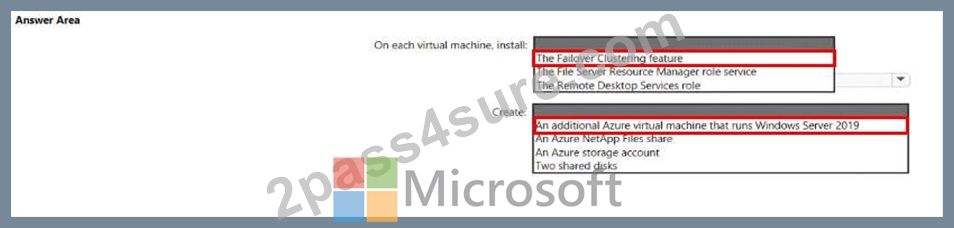
NEW QUESTION # 31
Which three PowerShell modules should you install on Server1 to meet the technical requirements? Each correct answer presents part of the solution.
NOTE: Each correct selection is worth one point.
- A. ActiveDirectory
- B. RemoteDesktop
- C. Pester
- D. Hyper-V
- E. ServerManager
Answer: A,C,D
Explanation:
Contoso identifies the following technical requirements:
From a server named Server1, convert the user profile disks to the FSLogix profile containers.
The PowerShell modules for Hyper-V, Active Directory, and Pester are prerequisites to running the cmdlets to convert user profile disks to FSLogix.
Reference:
https://docs.microsoft.com/en-us/azure/cloud-adoption-framework/migrate/azure-best-practices/contoso-migration-rds-to-wvd This is a case study. Case studies are not timed separately. You can use as much exam time as you would like to complete each case. However, there may be additional case studies and sections on this exam. You must manage your time to ensure that you are able to complete all questions included on this exam in the time provided.
To answer the questions included in a case study, you will need to reference information that is provided in the case study. Case studies might contain exhibits and other resources that provide more information about the scenario that is described in the case study. Each question is independent of the other questions in this case study.
At the end of this case study, a review screen will appear. This screen allows you to review your answers and to make changes before you move to the next section of the exam. After you begin a new section, you cannot return to this section.
To start the case study
To display the first question in this case study, click the Next button. Use the buttons in the left pane to explore the content of the case study before you answer the questions. Clicking these buttons displays information such as business requirements, existing environment, and problem statements. If the case study has an All Information tab, note that the information displayed is identical to the information displayed on the subsequent tabs. When you are ready to answer a question, click the Question button to return to the question.
Overview
Litware, Inc. is a pharmaceutical company that has a main office in Boston, United States, and a remote office in Chennai, India.
NEW QUESTION # 32
Your network contains an on-premises Active Directory domain named contoso.com that syncs to an Azure Active Directory (Azure AD) tenant.
You have an Azure subscription that contains an Azure Virtual Desktop host pool.
You create an Azure Storage account named storage1.
You need to use FSLogix profile containers in storage1 to store user profiles for a group named Group1. The solution must use the principle of least privilege.
What should you include in the solution? To answer, select the appropriate options in the answer area.
Answer:
Explanation:
Reference:
https://docs.microsoft.com/en-us/azure/storage/files/storage-files-identity-ad-ds-enable
https://docs.microsoft.com/en-us/azure/virtual-desktop/create-file-share
NEW QUESTION # 33
You network contains an on-premises Active Directory domain that syncs to an Azure Active Directory (Azure AD) tenant. The domain contains the users shown in the following table.
You have a Windows Virtual Desktop deployment that contains the application groups shown in the following table.
You have the workspaces shown in the following table.
For each of the following statements, select Yes if the statement is true. Otherwise, select No.
NOTE: Each correct selection is worth one point.
Answer:
Explanation:
Reference:
https://docs.microsoft.com/en-us/azure/virtual-desktop/environment-setup
NEW QUESTION # 34
Your company has 60,000 users.
You plan to deploy Azure Virtual Desktop.
You need to recommend a storage solution for the FSLogix profile containers. The solution must provide the highest possible lOPS and the lowest latency desktop experience What should you recommend?
- A. Azure Blob storage Premium
- B. Azure Data Lake Storage
- C. Azure Files Standard
- D. AzureNetAppFiles
Answer: D
NEW QUESTION # 35
You need to deploy the session hosts to meet the deployment requirements Which PowerShell cmdlel should you run first?
- A. Set-AzWMADDomainExtension
- B. Get-AzApiManagementSsoToken
- C. New-AzwvdRegistratrationinfo
- D. Update-AZwvdSessionHost
Answer: A
Explanation:
Reference:
https://rozemuller.com/avd-automation-cocktail-avd-automated-with-powershell/
NEW QUESTION # 36
You have an Azure subscription that contains a hybrid Azure Active Directory (Azure AD) tenant and two domain-joined Azure virtual machines. The virtual machines run Windows Server 2019 and contain managed disks.
You plan to deploy an Azure Virtual Desktop host pool that will use a Storage Spaces Direct Scale-Out File Server to host user profiles.
You need to ensure that the virtual machines can host the Storage Spaces Direct deployment. The solution must meet the following requirements:
* Ensure that the user profiles are available if a single server falls.
* Minimize administrative effort.
What should you do? To answer, select the appropriate options In the answer are a. NOTE: Each correct selection is worth one point.
Answer:
Explanation:
Reference:
https://docs.microsoft.com/en-us/windows-server/storage/storage-spaces/deploy-storage-spaces-direct
NEW QUESTION # 37
You have an Azure Virtual Desktop host pool named Pool1.
You need to ensure that you can create an Azure NetApp Files volume that will host user profiles for Pool1.
Which four actions should you perform in sequence? To answer, move the appropriate actions from the list of actions to the answer area and arrange them in the correct order.
NOTE: More than one order of answer choices is correct. You will receive credit for any of the correct orders you select.
Answer:
Explanation:
1 - Register the NetApp Resource Provider.
2 - Register for Azure NetApp Files.
3 - Create an Azure NetApp Files account.
4 - Create a capacity pool.
Reference:
https://docs.microsoft.com/en-us/azure/azure-netapp-files/azure-netapp-files-quickstart-set-up-account-create-volumes?tabs=azure-portal
NEW QUESTION # 38
You have an Azure Active Directory (Azure AD) tenant named contoso.com and an Azure virtual network named VNET1.
To VNET1, you deploy an Azure Active Directory Domain Services (Azure AD DS) managed domain named litwareinc.com.
To VNET1, you plan to deploy a Windows Virtual Desktop host pool named Pool1.
You need to ensure that you can deploy Windows 10 Enterprise host pools to Pool1.
What should you do first?
- A. Implement Azure AD Connect cloud sync.
- B. Modify the settings of the litwareinc.com DNS zone.
- C. Add a custom domain name to contoso.com.
- D. Modify the DNS settings of VNET1.
Answer: D
Explanation:
Reference:
https://docs.microsoft.com/en-us/azure/active-directory-domain-services/tutorial-create-instance
"Update DNS settings for the Azure virtual network With Azure AD DS successfully deployed, now configure the virtual network to allow other connected VMs and applications to use the managed domain. To provide this connectivity, update the DNS server settings for your virtual network to point to the two IP addresses where the managed domain is deployed."
NEW QUESTION # 39
You have an Azure Virtual Desktop host pool named Pool1 in the East US region.
You have a storage account named storage1 that contains FSLogix profile containers. In the East US region, you have a shared image gallery named SIG1 that contains a virtual machine image named Image1. Image1 is used to create new session hosts in Pool1.
You plan to deploy a new Azure Virtual Desktop host pool named Pool2 to the South India region.
You need to implement a session host deployment solution for Pool2 that meets the following requirements:
Image1 must replicate in the South India region.
The session hosts in Pool2 must be based on Image1.
Changes to Image1 must be available in the South India and East US regions.
What should you include in the solution?
- A. Create a new shared image gallery named SIG2 in the South India region. Upload a copy of Image1 to SIG2.
- B. Create a new Azure Storage account named storage2 in the South India region. Copy Image1 to a shared folder in storage2.
- C. Configure geo-redundant storage (GRS) replication for storage1. Copy the VHD file of Image1 to the FSLogix profile container.
- D. From SIG1, update the replication for the latest image version of Image1.
Answer: D
Explanation:
Reference:
https://docs.microsoft.com/en-us/azure/virtual-machines/shared-image-galleries
NEW QUESTION # 40
You have an Azure Virtual Desktop deployment.
You are configuring the outbound firewall settings for the host pool.
Which outbound URL and outbound port should you configure to ensure that the host machines maintain Windows activation? To answer, select the appropriate options In the answer area.
NOTE: Each correct selection is worth one point.
Answer:
Explanation:
Reference:
https://docs.microsoft.com/en-us/azure/virtual-desktop/safe-url-list
NEW QUESTION # 41
You have an Azure Virtual Desktop Deployment that contains a workspace named Workspace1 and a user named User1. Workspace1 contains a Desktop application group named Pool1Desktop.
At 09:00, you create a conditional access policy that has the following settings:
* Assignments:
- Users and groups: User1
- Cloud apps or actions: Azure Virtual Desktop
- Conditions: 0 conditions selected
* Access controls
- Grant: Grant access, Require multi-factor authentication
- Sessions: Sign-in frequency 1 hour
User1 performs the actions shown in the following table.
For each of the following statements, select Yes if the statement is true. Otherwise, select No.
NOTE: Each correct selection is worth one point.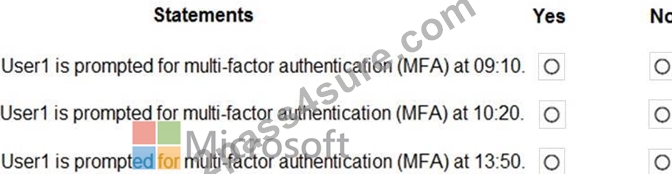
Answer:
Explanation:
Explanation
Text Description automatically generated
Reference:
https://docs.microsoft.com/en-us/azure/virtual-desktop/set-up-mfa
NEW QUESTION # 42
You need to ensure the resiliency of the user profiles for the Boston office users. The solution must meet the user performance requirements.
What should you do?
- A. Implement Azure Site Recovery.
- B. Modify the replication settings of storage1.
- C. Modify the Account kind setting of storage1.
- D. Configure Cloud Cache.
Answer: D
Explanation:
Reference:
https://docs.microsoft.com/en-us/azure/architecture/example-scenario/wvd/windows-virtual-desktop-fslogix
NEW QUESTION # 43
......
Validate your AZ-140 Exam Preparation with AZ-140 Practice Test: https://endexam.2pass4sure.com/Microsoft-Certified/AZ-140-actual-exam-braindumps.html