

Jul-2026 The Open Group OGBA-101 Actual Questions and Braindumps
OGBA-101 Dumps To Pass The Open Group Exam in 24 Hours - 2Pass4sure
NEW QUESTION # 87
What Is presented as striking a balance between positive and negative outcomes resulting from the realization of either opportunities or threats"?
- A. Agile development
- B. Risk Management
- C. Architecture Security
- D. Transition Management
Answer: B
Explanation:
Risk Management is the discipline that addresses the identification, assessment, and prioritization of risks followed by coordinated application of resources to minimize, control, and monitor the impact of unfortunate events or to maximize the realization of opportunities. It is about striking a balance between the positive outcomes of opportunities and the negative outcomes of risks, ensuring that the enterprise can achieve its objectives while keeping potential threats under control.
NEW QUESTION # 88
Which of the following best describes this diagram?
- A. Business Capabilities Layer diagram
- B. Business Capability/Value Stream Mapping
- C. Business Relationships diagram
- D. Business Capability Map
Answer: D
Explanation:
The diagram presented is best described as a Business Capability Map. Here's a detailed explanation:
Business Capability Map:
Definition: A Business Capability Map represents the various capabilities an organization requires to deliver its products and services and achieve its strategic objectives. It typically categorizes capabilities into different levels or tiers, such as strategic, core, and supporting capabilities.
Diagram Analysis:
Layers and Groupings: The diagram shows capabilities grouped into three categories: Strategic, Core, and Supporting. Each group lists specific business capabilities necessary for the organization's functioning.
Color Coding: The use of different colors (green, red, yellow, purple) may indicate various aspects such as priority, status, or different business units. However, the primary purpose is to visually represent and categorize capabilities.
TOGAF Reference:
Phase B: Business Architecture: In this phase, creating a Business Capability Map is a crucial activity. It helps in understanding the business functions and aligning them with strategic goals.
Capability-Based Planning: TOGAF promotes capability-based planning, which involves identifying, mapping, and analyzing business capabilities to ensure they support the overall strategy and objectives.
Purpose and Benefits:
Strategic Alignment: The Business Capability Map helps in aligning business capabilities with the strategic objectives of the organization. It provides a clear view of what the organization needs to do to achieve its goals.
Gap Analysis: It is useful for conducting gap analysis by comparing current capabilities with the desired state, helping to identify areas for improvement.
Resource Allocation: By understanding the different capabilities, organizations can allocate resources more effectively to areas that need development or enhancement.
In summary, the diagram is best described as a Business Capability Map because it visually represents and categorizes the various capabilities needed by the organization into strategic, core, and supporting layers, aligning them with the business strategy and objectives.
NEW QUESTION # 89
Which ADM phase focuses on defining the problem to be solved, identifying the stakeholders, their concerns, and requirements?
- A. Phase A
- B. Preliminary Phase
- C. Phase C
- D. Phase B
Answer: A
Explanation:
In the TOGAF ADM (Architecture Development Method), Phase A, also known as the Architecture Vision phase, is critical for defining the problem to be solved and identifying the stakeholders, their concerns, and requirements. Here's a detailed explanation:
Phase A: Architecture Vision:
Objective: The primary objective of Phase A is to establish a high-level vision of the architecture project. This includes defining the scope, identifying stakeholders, and understanding their concerns and requirements.
Stakeholder Identification: During this phase, all relevant stakeholders are identified. This includes business leaders, IT leaders, end-users, and other parties who have a vested interest in the architecture project.
Concerns and Requirements: Once stakeholders are identified, their concerns and requirements are gathered. This involves understanding their needs, expectations, and the issues they face that the architecture project aims to address.
Key Activities:
Problem Definition: Phase A focuses on clearly defining the problem or opportunity that the architecture project seeks to address. This sets the stage for developing the architecture vision and ensuring that the project aligns with business goals.
Developing the Architecture Vision: A key output of Phase A is the architecture vision, which provides a high-level overview of the desired future state. This vision is aligned with the business strategy and objectives.
Requirements Management: Phase A also involves establishing a requirements management process to ensure that stakeholder needs are captured, analyzed, and addressed throughout the architecture development process.
TOGAF Reference:
Phase A Deliverables: Key deliverables of Phase A include the Architecture Vision document, stakeholder map, and high-level requirements.
ADM Guidelines and Techniques: TOGAF provides guidelines and techniques for effectively conducting Phase A, including methods for stakeholder analysis, requirements gathering, and developing the architecture vision.
In summary, Phase A of the TOGAF ADM focuses on defining the problem to be solved, identifying stakeholders, understanding their concerns and requirements, and developing a high-level architecture vision that aligns with business objectives.
NEW QUESTION # 90
Which ADM phase focuses on defining the problem to be solved, identifying the stakeholders, their concerns, and requirements?
- A. Phase A
- B. Preliminary Phase
- C. Phase C
- D. Phase B
Answer: A
Explanation:
Phase A of the TOGAF ADM (Architecture Development Method), also known as the Architecture Vision phase, focuses on defining the problem to be solved, identifying stakeholders, their concerns, and requirements. Here's a detailed explanation:
Phase A: Architecture Vision:
Objective: The primary objective of Phase A is to establish a high-level vision of the architecture project, including defining the scope and identifying key stakeholders and their concerns.
Problem Definition: This phase involves clearly defining the business problem or opportunity that the architecture project seeks to address. This sets the stage for all subsequent architecture work.
Stakeholder Identification:
Identification and Analysis: Stakeholders are identified and their concerns and requirements are gathered. This includes business leaders, IT leaders, end-users, and other relevant parties.
Understanding Needs: Understanding the needs and expectations of stakeholders is crucial for ensuring that the architecture aligns with business objectives and addresses key concerns.
Requirements Gathering:
High-Level Requirements: In Phase A, high-level requirements are identified and documented. These requirements guide the development of the architecture vision and provide a basis for more detailed requirements in later phases.
Requirements Management: A requirements management process is established to ensure that stakeholder needs are continuously captured, analyzed, and addressed throughout the architecture development process.
TOGAF References:
Deliverables: Key deliverables of Phase A include the Architecture Vision document, stakeholder map, and high-level requirements.
ADM Guidelines: TOGAF provides guidelines and techniques for conducting Phase A, including methods for stakeholder analysis, problem definition, and developing the architecture vision.
In summary, Phase A of the TOGAF ADM focuses on defining the problem to be solved, identifying stakeholders, understanding their concerns and requirements, and developing a high-level architecture vision that aligns with business objectives.
NEW QUESTION # 91
Which of the following best describes the purpose of a Compliance Assessment?
- A. To provide a high-level view of the end architecture product.
- B. To govern the architecture throughout its implementation process.
- C. To show progression of change from the Baseline Architecture to the Target Architecture.
- D. To ensure that architecture information is communicated to the right stakeholders at the right time.
Answer: B
NEW QUESTION # 92
Consider the following example value stream:
What does this show?
- A. The value stream consists of five business capabilities.
- B. A decomposition into a sequence of value-creating stages.
- C. The service "Acquire Retail Product" consists of five events
- D. A series of five subprocesses that makeup the value stream
Answer: B
Explanation:
The example value stream shown, labeled "Acquire Retail Product," represents a decomposition into a sequence of stages that collectively create value. Each stage, such as "Advertise Channels," "Display Products," "Enable Selection," "Process Payment," and "Deliver Product(s)," is a step in the overall process that contributes to the final outcome, which in this case is the acquisition of a retail product by the customer. Value streams are utilized in business architecture to model the flow of value through an organization from the initial customer demand to the final delivery of the product or service.
NEW QUESTION # 93
Consider the following business capability map. where cells of a model are given different colors to represent maturity levels (note the letters G, R. Y. P also denote the colors used = Green, Red. Yellow and Purple):
Which of the following best describes this technique?
- A. Perspective Analysis
- B. Heat Mapping
- C. Capability Mapping
- D. Gap Analysis
Answer: B
Explanation:
The technique shown in the example is called heat mapping. It is a technique that can be used to show a range of different perspectives on a business capability map, such as maturity, effectiveness, performance, and value or cost contribution of each capability to the business2. Different attributes determine the colors of each capability on the business capability map. Heat mapping can help to identify strengths, weaknesses, opportunities, and threats in the business architecture.
https://governance.foundation/assets/frameworks/togaf/g189%20-%20Business%20Capbility.pdf Table 3: Heat Map for ABC Company's Business Capabilities
NEW QUESTION # 94
Complete the sentence. The four dimensions used to scope an architecture are:
- A. Strategy, Portfolio, Project, Solution Delivery
- B. Strategy, Segment, Capability, Budget
- C. Business, Data, Application, Technology
- D. Breadth, Depth, Time Period, Architecture Domains
Answer: D
Explanation:
In TOGAF, the dimensions for scoping an architecture are Breadth (coverage across the organization), Depth (level of detail), Time Period (horizon of the architecture), and Architecture Domains (the four architecture domains of Business, Data, Application, and Technology). These dimensions ensure comprehensive scoping and contextual alignment.
NEW QUESTION # 95
Where are business scenarios used most prominently in the TOGAF ADM?
- A. They are used in the Phase A to discover and document business requirements.
- B. They are used as part of the lessons learned activity at the end of Phase F.
- C. They are used to resolve impacts across the Architecture Landscape in Phases B, C, and D.
- D. They are used as part of a business transformation readiness assessment in Phase E.
Answer: A
Explanation:
Business scenarios are most prominently used in Phase A (Architecture Vision) of the TOGAF ADM. In this phase, they help in discovering and documenting business requirements by providing detailed and realistic descriptions of business situations. Business scenarios help in identifying the key business drivers, goals, and challenges, ensuring that the architecture development is aligned with the actual needs of the business.
NEW QUESTION # 96
Which of the following is a difference between an organization map and an organization chart?
- A. An organization map reduces the time, cost, and risk of business operations.
- B. An organization map improves the ability to deliver information within the organization by highlighting the consumers.
- C. An organization map highlights where in the organization that stakeholder concerns are not being addressed by a business architecture.
- D. An organization map describes the complex interactions and relationship within an organization.
Answer: D
Explanation:
An organization map provides a detailed representation of the complex interactions and relationships within an organization, going beyond the hierarchical structure shown in an organization chart. It includes the connections and dependencies between different business units, teams, and roles, offering a more comprehensive view of how the organization operates and collaborates to achieve its objectives.
NEW QUESTION # 97
Consider the diagram.
What are the items labelled A, B and C?
- A. A-Enterprise Architecture, B-Architecture Building Blocks, C-Solutions Building Blocks
- B. A-Architecture Vision, B-Business Architecture. C-lnformation Systems Architecture
- C. A-Enterprise Strategic Architecture, B-Segment Architecture, C-Solutions Architecture
- D. A-Enterprise Continuum, B-Architecture Continuum. C-Solutions Continuum
Answer: D
Explanation:
The diagram shows the Enterprise Continuum, which is a view of the Architecture Repository that provides methods for classifying architecture and solution artifacts as they evolve from generic Foundation Architectures to Organization-Specific Architectures4. The Enterprise Continuum comprises two complementary concepts: the Architecture Continuum and the Solutions Continuum. The Architecture Continuum shows the relationships among foundational frameworks, common system architectures, industry architectures, and enterprise architectures4. The Solutions Continuum shows the relationships among foundational solutions, common system solutions, industry solutions, and enterprise solutions4.
NEW QUESTION # 98
Refer to the table below:
Which ADM Phase(s) does this describe?
- A. Phase E
- B. Preliminary Phase
- C. Phase B
- D. Phase B. C and D
Answer: D
Explanation:
The table describes the steps involved in Phase B (Business Architecture), Phase C (Information Systems Architectures), and Phase D (Technology Architecture) of the TOGAF ADM5. These phases are responsible for developing the target architectures for each domain and identifying the gaps between the baseline and target architectures. The table shows the outputs and outcomes of each phase, as well as the essential knowledge required for each phase.
The table describes the iterative cycle of defining requirements, identifying gaps, and creating solutions that occurs throughout thearchitecture development phasesof the TOGAF ADM. This cycle is most prominent in:
* Phase B (Business Architecture):
* Develop the Business Architecture, identifying gaps between the baseline and desired business capabilities, processes, and information flows.
* Define work packages to address these gaps and realize the target business architecture.
* Phase C (Information Systems Architectures):
* Develop the Data and Application Architectures to support the Business Architecture.
* Identify gaps between the baseline and target information systems architectures.
* Define work packages to address these gaps and realize the target data and application architectures.
* Phase D (Technology Architecture):
* Develop the Technology Architecture to support the Data and Application Architectures.
* Identify gaps between the baseline and target technology architectures.
* Define work packages to address these gaps and realize the target technology architecture.
NEW QUESTION # 99
Consider the following modeling example, relating business capabilities to organization units so as to highlight duplication and redundancy: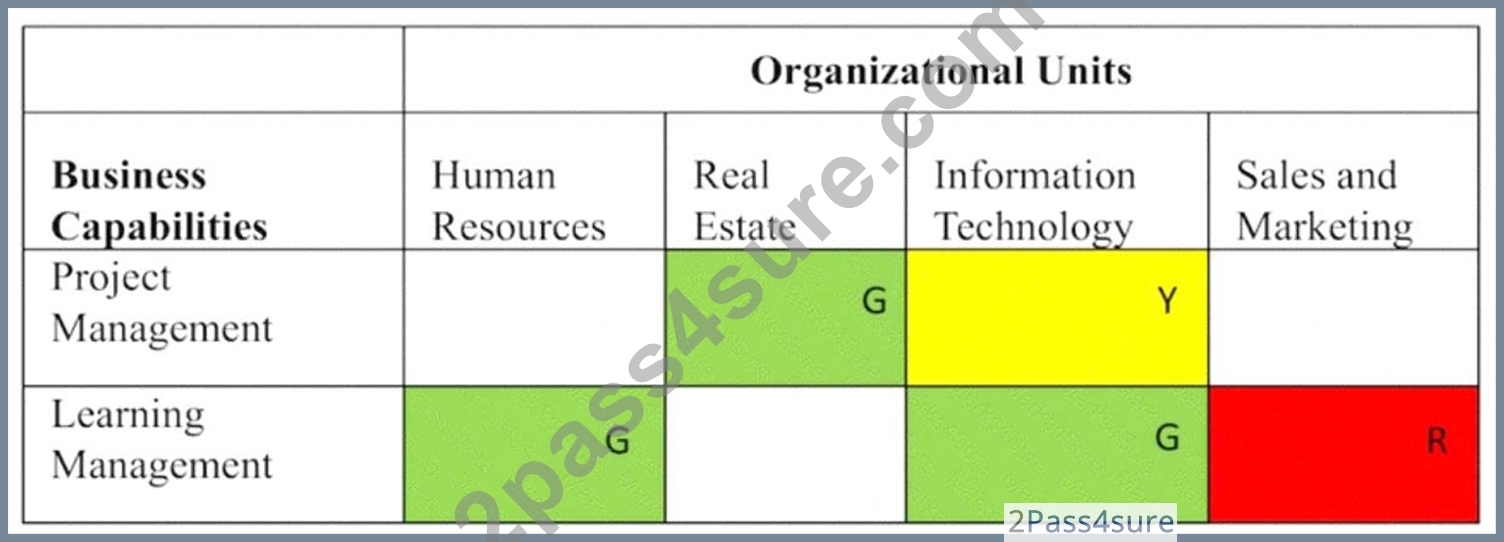
(Note in this example the cells colored green, yellow, and red, are also marked G. Y, and R, respectively) Which of the following best describes this technique?
- A. Perspective Analysis
- B. Capability Mapping
- C. Relationship Mapping
- D. Gap Analysis
Answer: C
Explanation:
The technique shown in the example is called relationship mapping. It is a technique that can be used to show how a business architecture addresses stakeholder concerns across different parts of an organization2. It can highlight gaps or overlaps in the coverage of stakeholder concerns by a business architecture. In this case, the technique is used to relate business capabilities to organization units so as to highlight duplication and redundancy.
This modeling technique is referred to as Relationship Mapping. It's used to relate business capabilities to organizational units to highlight areas of duplication and redundancy, as well as to indicate where capabilities are being performed well (green), where there are potential issues (yellow), and where there are significant problems or gaps (red). This visualization helps in understanding the alignment between organizational units and capabilities, and where improvements or changes may be needed.
5.2.1 Capability/Organization Mappinghttps://pubs.opengroup.org/togaf-standard/business-architecture
/business-capabilities.html#_Toc95135898
NEW QUESTION # 100
Which of the following are two of the four purposes that help frame the planning horizon, depth, and breadth of an Architecture Project?
1. Architecture to Support Strategy
2. Architecture to Support Capability
3. Architecture to Support Portfolio
4. Architecture to Support Agility
- A. 3 & 4
- B. 2 & 4
- C. 2 & 3
- D. 1 & 3
Answer: D
NEW QUESTION # 101
Which of the following is a derived relationship in an organization map?
- A. Value flow
- B. Scope of enterprise
- C. Location
- D. Capability
Answer: A
Explanation:
According to the TOGAF Series Guide: Organization Mapping, one of the derived relationships in an organization map is value flow. A value flow is a relationship that shows how value is exchanged between business units or other entities in an organization map. A value flow can be expressed as a verb phrase that indicates what type of value is transferred or shared between entities. For example, in an organization map for an online retailer, a possible value flow could be
"Delivers products" between the Warehouse business unit and the Customer entity.
NEW QUESTION # 102
Which of the following is a difference between an organization map and an organization chart?
- A. An organization map is limited to formal relationships between business units.
- B. An organization map reduces the time, cost, and risk of business operations.
- C. An organization map can be impacted by a business model change.
- D. An organization map highlights where in the organization that stakeholder concerns are not being addressed by a business architecture.
Answer: D
Explanation:
An organization map is a technique that can be used to show how a business architecture addresses stakeholder concerns across different parts of an organization. It can highlight gaps or overlaps in the coverage of stakeholder concerns by a business architecture. An organization chart, on the other hand, is a diagram that shows the formal structure and hierarchy of an organization, such as reporting relationships and roles. An organization chart does not necessarily show how stakeholder concerns are addressed by a business architecture.
An organization map differs from an organization chart in that it is designed to show more than just the formal hierarchy and relationships between different units within an organization. It provides a view of the enterprise from the perspective of the business architecture, highlighting areas where stakeholder concerns might not be addressed effectively, whereas an organization chart typically shows the formal reporting structures only.
NEW QUESTION # 103
What are the following activities part of?
* Initial risk assessment
* Risk mitigation and residual risk assessment
* Risk monitoring
- A. Phase A
- B. Security Architecture
- C. Risk Management
- D. Phase C
Answer: C
NEW QUESTION # 104
Which ADM phase focuses on defining the problem to be solved, identifying the stakeholders, their concerns, and requirements?
- A. Phase A
- B. Preliminary Phase
- C. Phase C
- D. Phase B
Answer: A
Explanation:
Phase A of the TOGAF ADM (Architecture Development Method), also known as the Architecture Vision phase, focuses on defining the problem to be solved, identifying stakeholders, their concerns, and requirements.
Phase A: Architecture Vision:
Objective: The primary objective of Phase A is to establish a high-level vision of the architecture project, including defining the scope and identifying key stakeholders and their concerns. Problem Definition: This phase involves clearly defining the business problem or opportunity that the architecture project seeks to address. This sets the stage for all subsequent architecture work.
Stakeholder Identification:
Identification and Analysis: Stakeholders are identified and their concerns and requirements are gathered. This includes business leaders, IT leaders, end-users, and other relevant parties.
Understanding Needs: Understanding the needs and expectations of stakeholders is crucial for ensuring that the architecture aligns with business objectives and addresses key concerns.
Requirements Gathering:
High-Level Requirements: In Phase A, high-level requirements are identified and documented.
These requirements guide the development of the architecture vision and provide a basis for more detailed requirements in later phases.
Requirements Management: A requirements management process is established to ensure that stakeholder needs are continuously captured, analyzed, and addressed throughout the architecture development process.
NEW QUESTION # 105
......
The Open Group OGBA-101 Exam Syllabus Topics:
| Topic | Details |
|---|---|
| Topic 1 |
|
| Topic 2 |
|
| Topic 3 |
|
| Topic 4 |
|
Download the Latest OGBA-101 Dump - 2026 OGBA-101 Exam Question Bank: https://endexam.2pass4sure.com/TOGAF-Business-Architecture-Foundation/OGBA-101-actual-exam-braindumps.html