

[UPDATED 2026] SRAN-Radio-Network-Performance-Optimization dumps Free Test Engine Verified By Certified Experts
Realistic SRAN-Radio-Network-Performance-Optimization Accurate & Verified Answers As Experienced in the Actual Test!
NEW QUESTION # 17
The CB009425 feature provides several enhancements to improve the transmission link budget for VoNR, offering a better customer experience. Which statements are correct regarding this feature?
- A. A, B, C, and D
- B. Packet Loss Rate, or PLR, for VoNR is minimized, improving voice call quality.
- C. A, B, and C
- D. A only
- E. B and C
- F. Specific initial BLER targets are used for VoNR DRBs.
- G. MCS downgrade control is used for VoNR DRBs.
- H. Configurable uplink minimum TBS is used for VoNR DRBs.
Answer: G
Explanation:
The correct answer is D.
The feature is focused on improving VoNR link robustness and user experience, especially near the cell edge or in difficult RF conditions. VoNR is sensitive to packet loss, delay, and uplink coverage limitations.
Therefore, link-budget improvement features commonly target BLER behavior, transport block sizing, and MCS robustness.
Statement A is correct because minimizing Packet Loss Rate, or PLR, directly improves VoNR speech quality and reduces mute, clipping, or robotic voice effects.
Statement B is correct because VoNR bearers can use specific initial BLER targets. A more suitable BLER target helps the scheduler choose a more robust MCS for voice traffic.
Statement C is correct because a configurable uplink minimum TBS, or Transport Block Size, helps ensure that small VoNR packets are transmitted efficiently and reliably.
Statement D is correct because MCS downgrade control can improve robustness by selecting a more conservative modulation and coding scheme for VoNR DRBs when radio conditions require it.
Therefore, all listed enhancements are part of the VoNR link-budget improvement concept:
A, B, C, and D.
NEW QUESTION # 18
Which statement is not true about MantaRay SON ?
- A. It supports multi-vendor and multi-technology RAN.
- B. Energy savings management is not covered.
- C. It has an open framework for module development.
- D. It was previously known as EdenNet SON.
Answer: B
Explanation:
The correct answer is B .
The statement "Energy savings management is not covered" is not true . Nokia describes MantaRay SON as supporting radio network performance, quality, and energy efficiency optimization. Nokia also references AI-powered energy savings management and RAN energy efficiency use cases under its SON/MantaRay automation portfolio.
The other statements are aligned with Nokia SON/MantaRay positioning. Nokia describes MantaRay SON as an automation layer within the MantaRay SMO framework, with support for multi-supplier/non-real-time RIC functionality and an application ecosystem. Nokia also has historical EdenNet SON material, including EdenNet SON Energy Saving Management.
Therefore, the statement that is not true is:
Energy savings management is not covered.
NEW QUESTION # 19
Which parameter defines the PRACH format ?
- A. msg1-FrequencyStart
- B. prachRootSequenceIndex
- C. totalNumberOfRAPreambles
- D. prachConfigurationIndex
Answer: D
Explanation:
The correct answer is B .
The prachConfigurationIndex defines the PRACH configuration, including the PRACH time-domain occasions and the associated PRACH format according to the PRACH configuration tables. In 5G NR, PRACH configuration is based on 3GPP-defined PRACH tables, where the configuration index maps to the PRACH format and PRACH occasion structure.
The other options have different meanings:
A). msg1-FrequencyStart defines the frequency-domain starting position of PRACH occasion resources.
C). prachRootSequenceIndex defines the root sequence used for PRACH preamble generation.
D). totalNumberOfRAPreambles defines how many random access preambles are available.
Therefore, the parameter that defines the PRACH format is:
prachConfigurationIndex.
NEW QUESTION # 20
Single Network Slice Selection Assistance Information , or S-NSSAI , identifies a network slice. Which of the following statements are correct regarding NSSAI ? Refer to the diagram for basic information.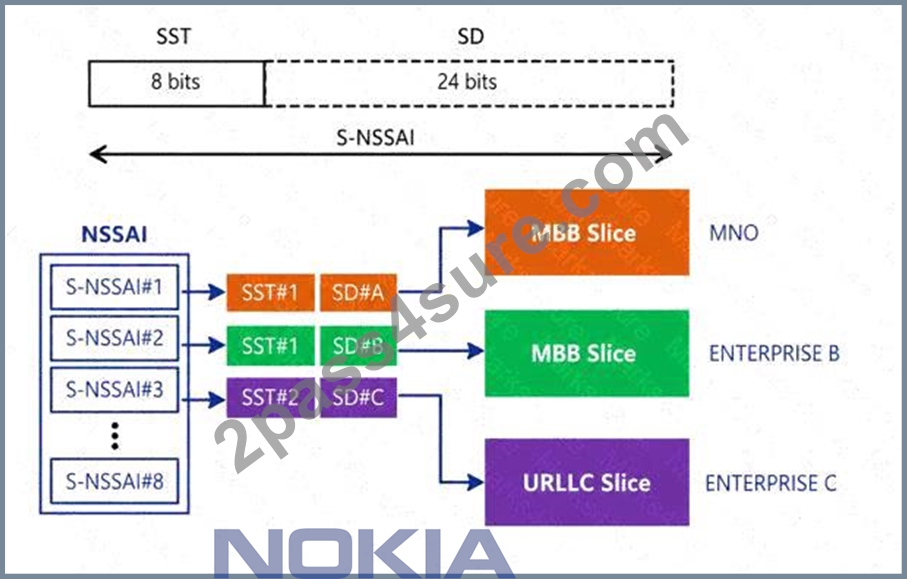
- A. SD , or Slice Differentiator , pairs with SST , or Slice/Service Type , to uniquely define a slice.
- B. SD , or Slice Differentiator , is an optional parameter that identifies or differentiates slices.
- C. A, B, C, and D
- D. The SST field may have standardized and non-standardized values.
- E. A, B, and C
- F. A and B
- G. SST , or Slice/Service Type , is a mandatory numeric parameter that refers to defined slice characteristics.
- H. B, C, and D
Answer: D
Explanation:
The correct answer is D: A, B, C, and D .
In 5G network slicing, S-NSSAI identifies a single network slice. It is composed of:
SST , or Slice/Service Type
SD , or Slice Differentiator
Statement A is correct.
The combination of SST + SD can uniquely identify a slice. For example, two slices may both use SST 1 for eMBB/MBB-type service, but different SD values can separate them for different enterprises, tenants, or service groups.
Statement B is correct.
SST is mandatory. It is an 8-bit numeric field that indicates the expected slice/service behavior, such as eMBB, URLLC, or mMTC.
Statement C is correct.
SD is optional. It is a 24-bit field used to differentiate multiple slices that may share the same SST.
Statement D is correct.
SST may use standardized values, such as SST 1 for eMBB, SST 2 for URLLC, and SST 3 for mMTC/MIoT.
It may also use operator-specific or non-standardized values depending on deployment requirements.
NEW QUESTION # 21
Which of the following best describes one of the primary purposes of the Coverage and Quality use case?
- A. To replace the Kronos parser during troubleshooting
- B. To configure the VPN tunnel for secure data transfer
- C. To convert LCBIN files to CSV files for analysis
- D. To identify problem areas such as low coverage or high interference
Answer: D
Explanation:
The correct answer is B .
The Coverage and Quality use case is used in network planning and optimization to identify RF problem areas. These may include:
Low RSRP or weak coverage areas
Poor SINR or low radio quality areas
High interference zones
Overshooting cells
Coverage holes
Areas where users experience poor throughput or poor accessibility
This type of use case helps NPO engineers prioritize optimization actions such as antenna tilt changes, azimuth changes, parameter tuning, neighbor optimization, power adjustment, or site expansion.
The other options are not the primary purpose:
VPN tunnel configuration is a connectivity/security task.
LCBIN-to-CSV conversion is a data processing task.
Replacing the Kronos parser is a tool-chain or troubleshooting function, not the main purpose of coverage and quality analysis.
So the best answer is:
To identify problem areas such as low coverage or high interference.
NEW QUESTION # 22
In a 5G cell , the following parameter has been modified: lowLatencyReservation = 15 .
Which percentage of UEs will be reallocated to a higher SR periodicity group whenever the threshold for moving to a higher SR periodicity group is reached?
- A. 1.00
- B. 0.85
- C. 0.15
- D. 0.50
Answer: B
Explanation:
The correct answer is C .
In 5G uplink scheduling, SR , or Scheduling Request , is used by the UE to request uplink resources when it has data to send. SR periodicity affects uplink latency and PUCCH capacity: shorter SR periodicity gives lower latency but consumes more control-channel resources, while longer SR periodicity saves resources but increases delay.
The parameter lowLatencyReservation = 15 means 15% of the UE/resource share is reserved for the low- latency SR periodicity group. When the load threshold is reached, the remaining portion can be moved to a higher SR periodicity group.
Calculation:
100% # 15% = 85%
So the percentage of UEs that can be reallocated to a higher SR periodicity group is:
0.85 , or 85% .
NEW QUESTION # 23
In a high-mobility network, the maximum cell size must be restricted to 33 km . Which PRACH format and restricted-set type should be used?
- A. Format 0 / Type B
- B. Format 1 / Type B
- C. Format 2 / Unrestricted Type
- D. Format 1 / Type A
Answer: B
NEW QUESTION # 24
What is the mandatory prerequisite to implement DSS , or Dynamic Spectrum Sharing ?
- A. TDD configuration only
- B. RF module sharing
- C. Same bandwidth for LTE and NR
- D. Dedicated NR spectrum
Answer: B
Explanation:
The correct answer is D .
DSS allows LTE and 5G NR to share the same spectrum dynamically , instead of requiring a separate dedicated NR carrier. Therefore, dedicated NR spectrum is not mandatory. DSS is also not limited to TDD only; it is commonly used in FDD spectrum refarming scenarios as well. Public RAN references describe DSS as a mechanism where LTE and NR coexist in the same frequency band and share spectrum dynamically.
From an SRAN architecture point of view, the mandatory deployment condition is that the radio platform must support LTE and NR coexistence on the same radio resources. That requires RF module sharing or a DSS-capable shared radio configuration.
So the correct prerequisite is:
RF module sharing.
NEW QUESTION # 25
Evaluate the impact of extended FR2 cell range on power consumption.
- A. It reduces power consumption by optimizing beamforming.
- B. It increases power consumption because UEs need more energy to transmit uplink signals.
- C. It has no impact on power consumption.
- D. It decreases power consumption due to better radio conditions.
Answer: B
Explanation:
The correct answer is C .
In FR2/mmWave , uplink coverage is often the limiting factor because UE transmit power is much lower than gNodeB transmit power, and mmWave propagation suffers from high path loss and blockage. Ericsson's mmWave coverage discussion also notes that high-band coverage is limited by uplink signal quality and high- band propagation characteristics.
When the FR2 cell range is extended, UEs farther from the serving cell must transmit uplink signals over a more difficult radio path. This usually requires higher UE transmit power, more robust MCS, more repetitions or retransmissions, and potentially longer uplink activity. As a result, UE battery consumption can increase.
Therefore, extended FR2 range generally:
Increases power consumption because UEs need more energy to transmit uplink signals.
NEW QUESTION # 26
In NR SA Option 2, the UE is camped on an SA serving cell. An IRAT handover is triggered for a multi-QCI call, QCI 1 and QCI 6, due to weak coverage of the serving cell. What will happen to both QCIs during the IRAT handover toward LTE?
- A. IRAT handover is not supported in SA Option 2.
- B. The QCI 1 bearer, or voice call, will be released, while the QCI 6 data bearer will continue on LTE.
- C. The QCI 1 bearer, or voice call, and the QCI 6 data bearer will both continue on LTE.
- D. The QCI 1 bearer, or voice call, will continue on LTE, while the QCI 6 data bearer will be released.
Answer: C
Explanation:
The correct answer is D.
In 5G SA Option 2, NR works independently with the 5G Core, but interworking with LTE/EPC can be supported for mobility continuity. When IRAT handover toward LTE is triggered due to weak NR coverage, the goal is to preserve the active services during mobility.
For a multi-QCI service:
QCI 1 normally represents the voice bearer, such as VoLTE/IMS voice continuity after movement to LTE.
QCI 6 normally represents a non-GBR data bearer.
During a supported IRAT handover from NR SA to LTE, both the voice bearer and data bearer can be transferred to LTE, assuming proper interworking, bearer mapping, and LTE coverage availability.
Option C is incorrect because IRAT mobility from NR SA to LTE is supported in properly configured networks. Option A is incorrect because the voice bearer is the most critical bearer to preserve. Option B is also not the best answer because the data bearer does not necessarily need to be released during IRAT handover.
Therefore, the expected result is:
Both QCI 1 voice and QCI 6 data continue on LTE.
NEW QUESTION # 27
Evaluate the impact of using MantaRay SON's centralized PCI optimization module compared to distributed SON implementations.
- A. Distributed SON implementations provide better optimization benefits.
- B. Centralized PCI optimization offers less visibility into network configuration.
- C. Distributed SON implementations are more effective in handling multi-vendor networks.
- D. Centralized PCI optimization can identify and resolve PCI issues across multi-vendor networks.
Answer: D
Explanation:
The correct answer is C .
A centralized SON approach has broader network-level visibility than a purely distributed implementation.
For PCI optimization , this is important because PCI conflicts, PCI confusion, and neighbor-related PCI issues are not always local to one cell. They may involve several neighboring cells, multiple layers, and sometimes multiple vendors.
Nokia positions MantaRay SON as a centralized, AI-powered network optimization and automation platform for improving RAN quality, efficiency, and customer experience. Nokia also describes MantaRay SON as supporting multi-supplier/non-real-time RIC functionality in the MantaRay SMO framework.
So compared with distributed SON, centralized PCI optimization can better analyze wider-area PCI relationships and resolve PCI problems across multi-vendor or multi-layer networks.
Therefore, the correct statement is:
Centralized PCI optimization can identify and resolve PCI issues across multi-vendor networks.
NEW QUESTION # 28
Choose the correct statement from the options below.
- A. Beamforming and MIMO cannot be used together.
- B. Beamforming and MIMO are the same.
- C. MIMO focuses on directing the signal, while beamforming focuses on utilizing multiple paths for data transmission.
- D. Beamforming focuses on directing the signal, while MIMO focuses on utilizing multiple paths for data transmission.
Answer: D
Explanation:
The correct answer is B .
Beamforming is mainly about shaping and directing radio energy toward a UE or a target area. It improves coverage, SINR, and cell-edge performance by focusing the transmitted or received signal in a specific direction.
MIMO , or Multiple Input Multiple Output , uses multiple antenna paths to improve throughput, reliability, and spectral efficiency. MIMO can be used for spatial multiplexing, diversity, or beamforming depending on the antenna system and radio configuration.
Option A is incorrect because beamforming and MIMO are related but not the same.
Option C reverses the definitions.
Option D is incorrect because beamforming and MIMO are commonly used together, especially in Massive MIMO systems.
So the correct statement is:
Beamforming focuses on directing the signal, while MIMO focuses on utilizing multiple paths for data transmission.
NEW QUESTION # 29
At which mark are all conditions fulfilled for energy saving , so the cell will be switched off? Refer to the image below.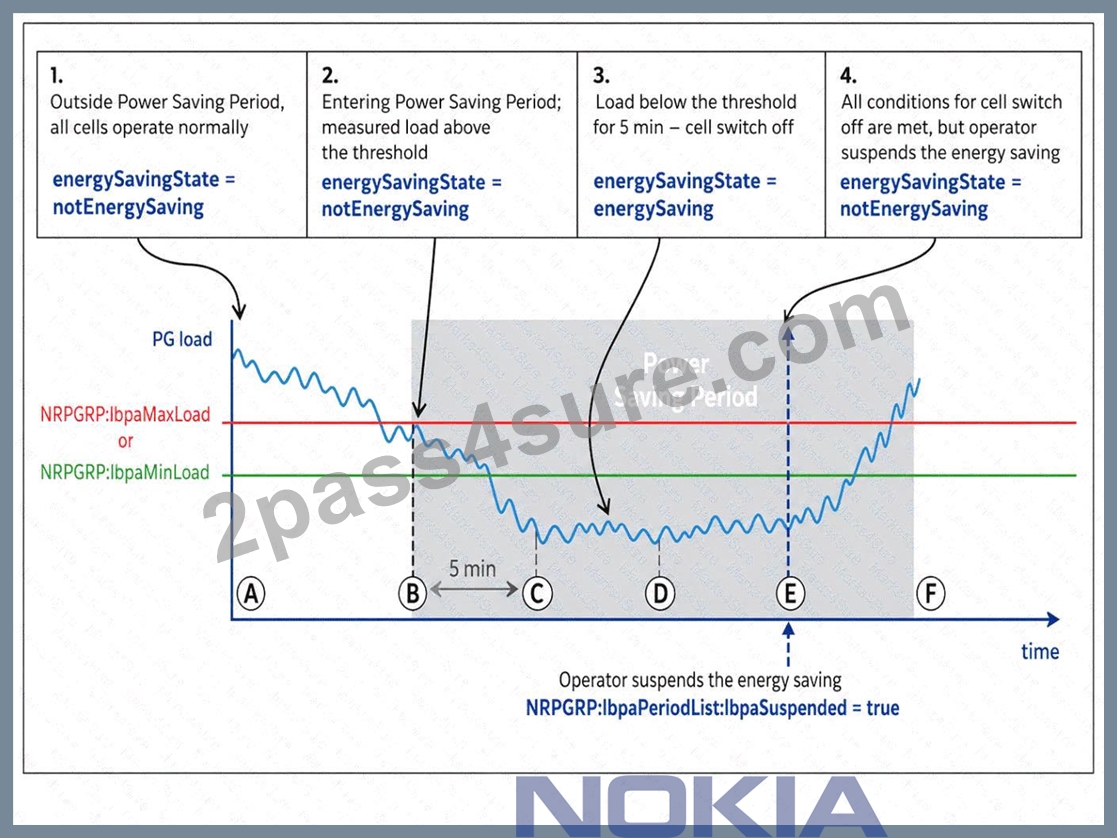
- A. B
- B. C
- C. E
- D. D
Answer: B
Explanation:
The correct answer is B , which corresponds to mark C in the diagram.
In the diagram, the energy-saving process follows these stages:
Before mark B , the cell is entering the power-saving period, but the required load condition has not yet been satisfied for the required duration.
At mark B , the measured load has gone below the configured threshold, but the cell is not switched off immediately. The system must confirm that the load remains below the required threshold for the configured time.
At mark C , the load has stayed below the required threshold for the required duration, shown as 5 minutes in the diagram. At this point, all conditions are fulfilled, and the cell can be switched off. The diagram also shows the state becoming:
energySavingState = energySaving
Marks D and E are already inside or near the later part of the power-saving period. Mark E is associated with operator suspension/exit behavior, not the initial moment when all switch-off conditions are first fulfilled.
NEW QUESTION # 30
......
Latest Nokia SRAN-Radio-Network-Performance-Optimization Practice Test Questions: https://endexam.2pass4sure.com/MN-NCSS-NPS-SRAN/SRAN-Radio-Network-Performance-Optimization-actual-exam-braindumps.html